As I sit here in 2026, still waiting for Grand Theft Auto 6 to finally roll into our lives, I can't help but reflect on the sheer audacity of Rockstar's timeline. If the grapevine was even half-right and the game was originally gunning for a 2024 launch, we're now looking at a gap of well over a decade between mainline entries—and honestly, at this point, that's just icing on the cake. A lot has changed in the open-world landscape since GTA 5 first dropped, and yet, I've got this gut feeling that Rockstar couldn't care less. They've been doing their own thing for ages, and if Red Dead Redemption 2 taught us anything, it's that they are stubborn as a mule when it comes to following the herd.
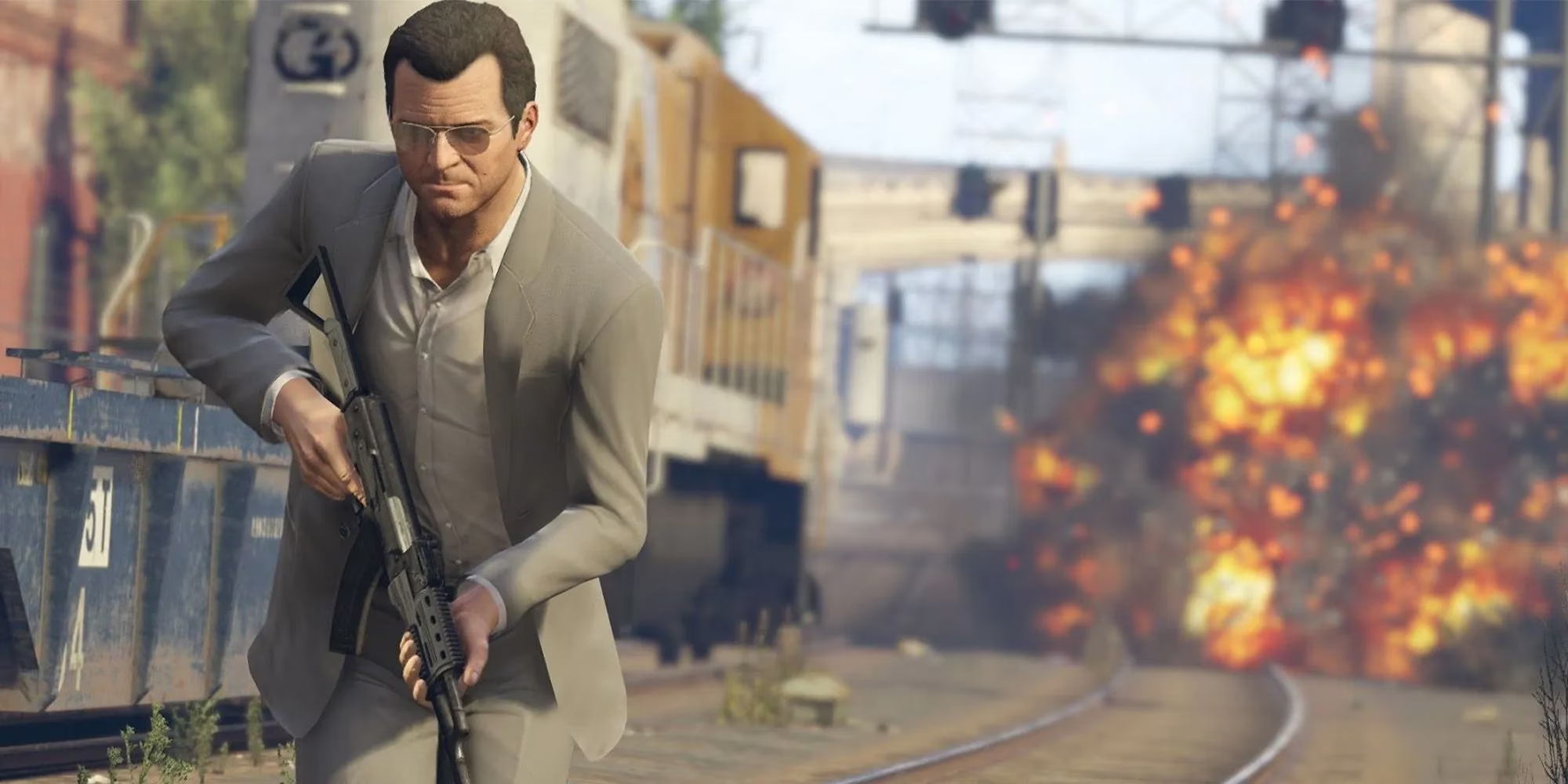
GTA 5 never really left us, of course—it thrived on re-releases and the endless money-printing machine that is GTA Online. But that constant presence makes it all too easy to forget just how many paradigm-shifting sandbox games have barged in since 2013. We're talking about the narrative depth of The Witcher 3, the procedural wonder of No Man's Sky, the pure, unadulterated freedom of Breath of the Wild, the existential mind-bend of Outer Wilds, the lonely hiking sim vibes of Death Stranding, the punishing open world of Elden Ring, and the physics-bending genius of Tears of the Kingdom. These aren't just great games; they fundamentally rewired what players expect from an open world. The genre didn't just evolve—it sprouted wings and learned to fly.
But here's the kicker: Rockstar has never shown even the slightest interest in picking up what other devs are putting down. Look at RDR2, which is an all-time favorite of mine. That game is defiantly, almost aggressively, different from the PS4-era mainstream. It doubles down on Rockstar's mechanical tics—for better and for worse. You still fail a mission if you wander three feet outside an invisible boundary. It still demands you complete tasks in one very specific way, or else you're slapped with a "Mission Failed" screen and forced to do it all over again. Every tiny, barely noticeable action is animated within an inch of its life—I swear, I've lost count of the number of times I've had to read about "dynamic horse testicles" while diving into RDR2 analyses. The controls? Still convoluted. You still need to hammer that X button like a madman just to sprint. Red Dead Redemption 2 didn't feel like a 2018 game. Its chief GOTY rival, God of War, was chasing industry trends set by The Last of Us, but RDR2 was still in conversation with design decisions Grand Theft Auto: San Andreas made over a decade earlier. Rockstar is a studio that primarily talks to itself, crunching relentlessly to surpass its own previous work—not anyone else's.
That's precisely why I don't expect GTA 6 to look anything like a "modern" game, whatever the hell that even means anymore. I've seen folks wonder if GTA 6 will follow in the footsteps of Elden Ring or Tears of the Kingdom and include some massive underground area to explore. Honestly? I just can't see it. For Rockstar to go down that route, they'd actually have to pay attention to what FromSoftware and Nintendo are doing, and I'm not convinced they do. I don't mean individual devs at Rockstar don't play those games—they're human, they probably do. I mean the studio as a monolithic entity operates as if no other games exist on the planet. They've been in their own bubble since the early 2000s, and that bubble is made of iron.
So what will GTA 6 actually play like when it finally lands? Here's my hot take: it's going to look like a game from 2028 but play like a game from 2007. It'll make mechanical choices that seem utterly bizarre in 2026, but it will do them with a level of visual fidelity and detail that will make most other games look like potato art. The controls will annoy the living daylights out of you—expect to wrestle with horses or, God forbid, cars, in ways that feel archaic. But the moment you set foot in that world, you'll be utterly compelled to explore every nook and cranny. The story? Remarkably accomplished and yet strangely juvenile, because that's the Rockstar trademark—highbrow satire mixed with lowbrow gags. It'll be a Rockstar game through and through, and for better or worse, it won't resemble anything else on the market. In an era where open-world design has become a checklist of copy-paste mechanics, that unapologetic stubbornness might just be exactly what we need. I'm ready to be frustrated and awed in equal measure—bring on the chaos.
The analysis is based on reporting from GamesIndustry.biz, and it helps frame why a GTA 6 that “plays old but looks next-gen” is a plausible outcome: when a single franchise dominates engagement and revenue for years, the business incentive often shifts from chasing every new open-world fad to refining a proven production pipeline and shipping a blockbuster that can sustain another long tail. That context aligns with the idea that Rockstar may double down on its signature, tightly authored mission structure and hyper-detailed simulation rather than adopt trend-driven mechanics like sprawling underground layers or systemic crafting sandboxes.