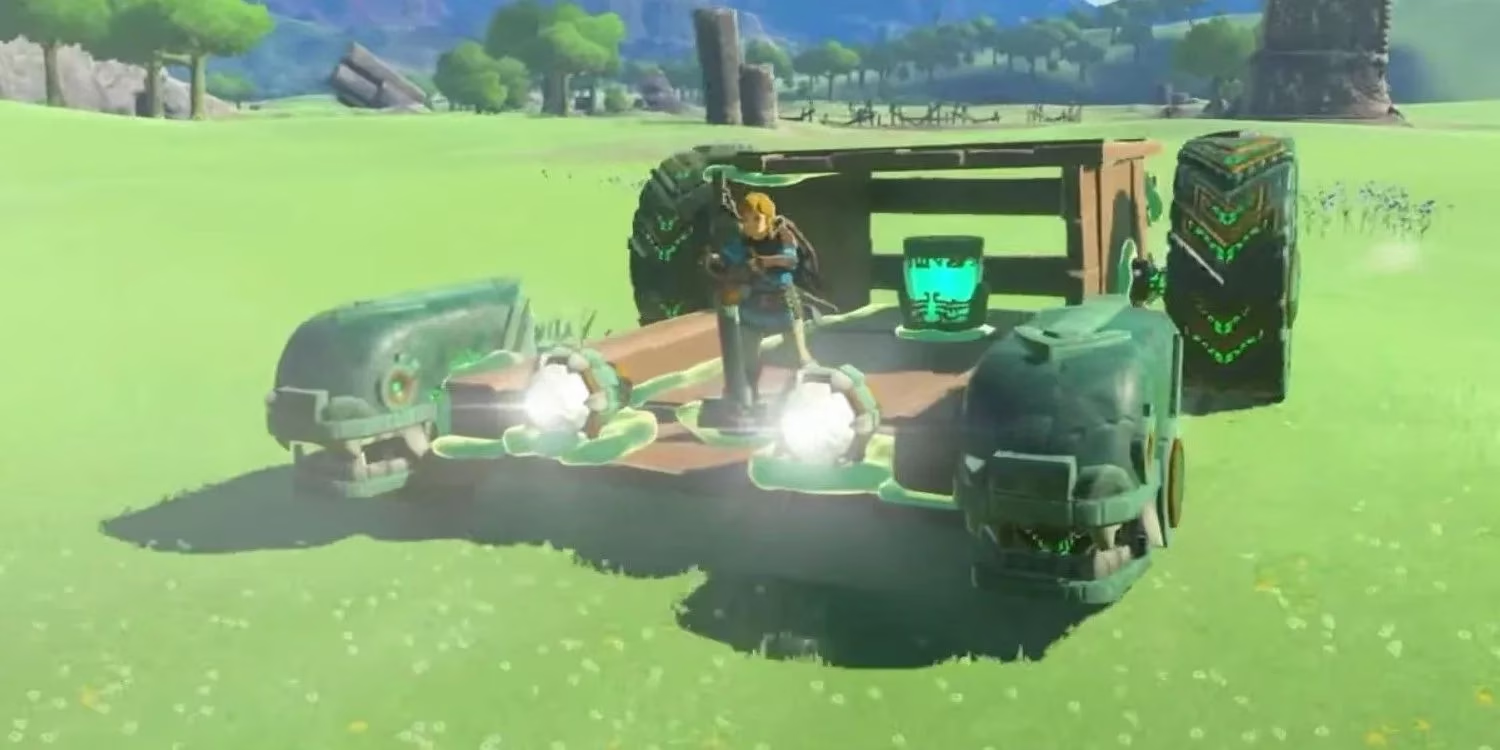
As I sit here in 2026, tinkering with my latest contraption—a dubious flying machine powered by three fans, a steering stick, and what I can only describe as ‘hope’—I’m still amazed by the sheer creative chaos The Legend of Zelda: Tears of the Kingdom unleashed. It turns out, the glorious, janky, and utterly brilliant freedom we got wasn't an accident. It was the result of the developers at Nintendo committing to a wild, physics-driven philosophy and then having the courage to follow through, even when everything—and I mean everything—started exploding.
Let me paint you a picture of the early days. According to the developers who spilled the beans at the 2024 Game Developer Conference, their goal was audacious: create a world where every single object played by the same set of physical rules. No cheating. No shortcuts. Senior Director Takuhiro Dohta, Sound Programmer Junya Osada, and Physics Programmer Takahiro Takayama called this "multiplicative gameplay," a fancy term for "let's see what happens when we throw a bunch of interactive stuff together and run for cover." Their dream was a system where unique, unscripted interactions could happen without a programmer having to code each one individually.

The Great Purge of Hyrule
To achieve this, Nintendo had to perform what I can only call The Great Purge. Early prototypes were, in their words, pure chaos. Objects would clip through the world, go careening into the stratosphere, or simply refuse to behave. The solution? Radical. They removed every single item in Hyrule that wasn't governed by their new, unified physics engine and replaced them with ones that were. Imagine the scene: a team of developers systematically deleting trees, rocks, and pots, only to painstakingly rebuild the world from the ground up with objects that could realistically roll, bounce, and smash. This wasn't just a technical overhaul; it was a philosophical commitment to consistency.
The hilarious (and genius) side effect of this was that even the developers started solving their own puzzles in ways they never intended. They'd build a shrine expecting a specific solution, only to find three other perfectly valid—and often more fun—methods using the game's physics. This directly translated to our experience. Remember the first time you bypassed an entire puzzle by sticking a rocket to a shield? Or built a wonky bridge out of logs instead of finding the "correct" path? That was the magic of their system working as designed.
A Symphony of Chaos: The Physics Engine for Sound
Now, here's a layer of brilliance I bet most players never consciously noticed, but felt deeply: the sound design. Junya Osada revealed that sound followed the same "multiplicative" principle. There isn't a single, pre-recorded "car engine" sound that plays when you build a vehicle. Instead, the game has a what the director called a "physics engine for sound."
Think about it. The roar of your creation is generated in real-time based on:
-
What's colliding: Wheels on sand vs. wheels on stone.
-
The size and shape of objects: A big, heavy plank drags differently than a small, light one.
-
The material: Wood creaks, metal clangs, Zonai devices hum.
It creates a dynamic, ever-changing soundscape that makes every contraption feel uniquely yours. The clatter of your haphazard flying machine sounds different from the smooth whir of a well-built hoverbike, because it is different. The audio isn't just a soundtrack; it's a live report from your physics experiment.
Why It All Mattered: The Legacy of Creative Freedom
Looking back from 2026, it's clear this wasn't just a neat tech demo. This foundational work is why Tears of the Kingdom wasn't just a 2023 Game of the Year contender; it became a persistent playground. The campaign was fantastic, but the real longevity came from the sandbox. Players kept coming back for years to:
-
Build increasingly absurd and functional machines (from functional Gundams to automatic Korok torture devices 😈).
-
Share their creations on social media, creating a perpetual cycle of inspiration and one-upmanship.
-
Simply experiment with the joyful, systemic interactions of the world.
The Ultrahand ability wasn't just a tool; it was the embodiment of Nintendo's design gamble. They gave us a consistent, rules-based world and said, "Go nuts." And we did. The fact that my save file from launch day is still active, now filled with strange monuments to my engineering "prowess," is a testament to their success.
The Takeaway for a Player in 2026
So, what's the lesson for us, the players reveling in this legacy? It's that true innovation in games often comes from restraint and consistency, not just adding more stuff. By committing to a single, robust physics system for everything—from a rolling apple to a colossal flying fortress—Nintendo didn't just create a game. They created a possibility space. They built a digital toybox where the rules are clear, the tools are powerful, and the only limit is your imagination (and occasionally, the object limit before your Switch starts crying).
Every time I glue a rocket to a minecart and call it public transportation, I'm not just playing a game. I'm participating in the chaotic, beautiful result of a developer's crazy dream to make a world that truly plays by its own rules. And honestly, I wouldn't have it any other way. Now, if you'll excuse me, I have to see if I can attach a Flame Emitter to a Cucco. For science, of course.