When players first dropped into Hyrule back in 2023, the debate began almost immediately. Fast forward to 2026, and the community has settled into some strong opinions, but new voices still find surprises in how wildly different one dungeon run can be from another. The Legend of Zelda: Tears of the Kingdom didn’t just hand players a set of keys and locked doors. It handed them a physics playground, a handful of Zonai devices, and the quiet confidence to break every intended solution. That sandbox nature meant the “best” and “worst” dungeon experiences could swap places depending entirely on a player’s creativity—or their stubborn refusal to use a minecart properly.
What makes a Temple truly great here isn't just complexity. It's the way it balances that old-school Zelda intention with the modern freedom to ascend through ceilings, fuse random objects to shields, or rewind a fallen block straight back to the sky. Some dungeons nailed this tightrope walk. Others stumbled, leaving players more frustrated than fulfilled. Let's walk through them all, ranking what worked, what didn't, and why the conversations still haven't stopped three years later.
Lightning Temple
Contained within a massive pyramid, the Lightning Temple stands as the closest thing Tears of the Kingdom has to a classic Zelda dungeon. The moment players step inside, there are traps to spot, blocks to shift, and beams of light demanding reflective mirrors. Every path feels deliberately crafted, yet the game still manages to express that signature openness through simultaneous navigation and environmental puzzle-solving.
People who played co-op style, even backseat gaming with friends, often had the best time here. One person watches for the light beam angle, another tracks the Gibdo nests. The Temple’s boss also throws a genuine curveball by surprising players right at the entrance, which set a tense, urgent tone right from the start. The only real drag? Keeping Riju close enough to use her Sage power. Tasked with protecting her lightning ability while dodging swarms, players frequently found the pacing stuttering. She’d lag behind, get stuck on geometry, or simply not be where the camera expected.
Despite that companion AI friction, the Lightning Temple remains a masterclass in dungeon atmosphere. The echoing sound design, the dust motes floating in shafts of light, the genuine feeling of unraveling an ancient, forgotten place—it all clicks. For anyone craving that tight, intentional Zelda feeling without losing Tears of the Kingdom’s identity, this is the gold standard.
Spirit Temple
Few dungeons have inspired as much heated back-and-forth as the Spirit Temple. The twist is immediate: the Temple itself is just a boss chamber. The real meat is the Construct Factory, a sprawling challenge spread across the Depths. After clearing a sky-based preliminary trial, players descend into darkness to assemble four limbs for Mineru’s robot body.
Here’s where things fracture. Some players will meticulously drag every limb through complex Ultrahand builds, crafting elaborate bridges and catapults. For them, it’s the single best application of the Zonai abilities in the entire game—a glorious, open-ended engineering project. Other players? They’ll find the process crushingly repetitive. Haul a block. Fuse some fans. Haul another block. The Depths environment, while atmospheric, doesn’t change much during this phase, and without a clear sense of pacing, it drags.
Calling the Spirit Temple an entirely new concept for a Zelda dungeon is fair, and as a first effort at something this ambitious, it’s impressive. The strange, melancholy tone of helping Mineru is unforgettable. Still, the execution splits right down the middle. In 2026, many veterans still argue it belongs at the very top or the very bottom of any ranking, with almost no one placing it in the middle.
Wind Temple
Simple, solid design doesn’t get enough credit, and the Wind Temple is here to prove why. Taking the shape of a colossal floating vessel surrounded by smaller ships, this dungeon cleverly melds ice and wind themes without ever tripping over its own ambition. The massive central structure, frozen sails snapping in the wind, gives a sense of scale that’s breathtaking without being overwhelming.
The difficulty is paced for players likely encountering it early in their journey. That’s not a weakness—it’s intentional reassurance. Puzzles guide instead of stump, and the environment naturally steers players toward solutions. Paired with one of the most useful Sage allies in the entire game, it’s clear the Wind Temple was designed to ease players into the rhythm of TotK’s dungeon design.
Then comes Colgera. The boss fight isn’t just a setpiece—it’s an epic, sky-diving ballet that still gets shared on social media in 2026. Soaring through the storm, diving through weak points as the orchestral score swells, players consistently rate this as one of the most exhilarating moments in any Zelda game. The Wind Temple might lack punishing difficulty, but it never fails to deliver pure, joyful spectacle.
Fire Temple
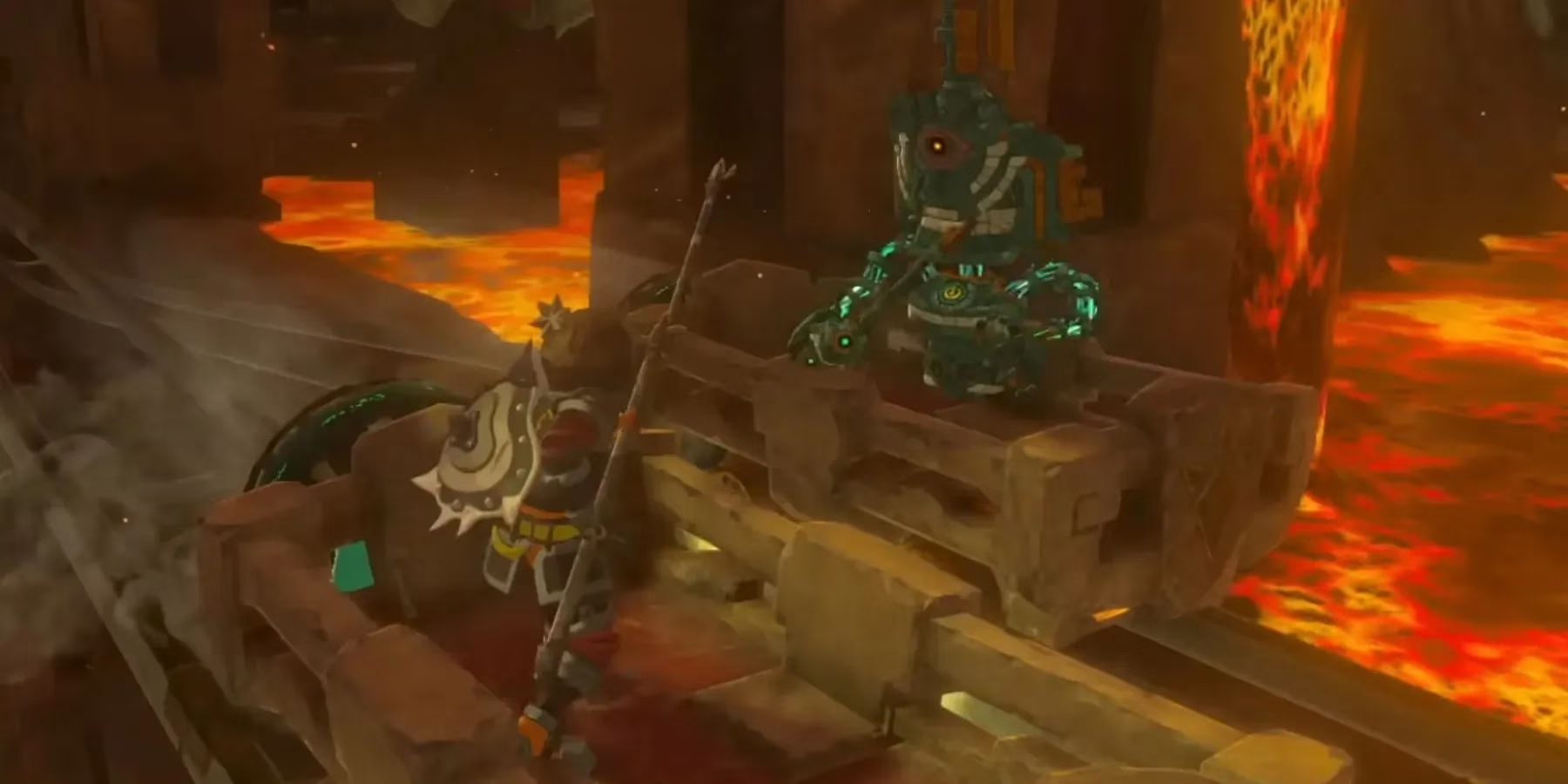
The Fire Temple sparks almost as much debate as the Spirit Temple, but for completely different reasons. Built into the depths of Death Mountain, the dungeon features fully climbable walls and a maze of minecart tracks running over lava flows. Yunobo’s ranged Sage power, intended for blasting rock walls, can also be used to skip massive chunks of the intended path.
This is where Tears of the Kingdom’s strengths and weaknesses collide. Players who accidentally bypass puzzles might feel cheated, while those who deliberately engage with the intricate cart systems and lava flow mechanics discover a genuinely rewarding web of locked doors, switch puzzles, and vertical layering. Getting lost is almost guaranteed—the sheer size makes tracking objectives a genuine struggle, even with the map fully revealed.
The boss fight splits opinion too, but at least it comes with a nice piece of Zelda history: a proper Gohma return. Watching that familiar single eye emerge from volcanic rock was a nostalgic thrill for long-time fans. The Fire Temple isn’t perfect, but for players willing to resist the urge to cheat with climbing and explosions, it offers one of the most involved navigational challenges in the entire game.
Water Temple
Something about Water Temples and controversy in Zelda games—it’s practically a tradition now. This floating, open-air structure sits in the sky like the Wind Temple but plays out completely differently. Arranged as a cluster of distinct sky islands, navigation borders on trivial. There’s no central structure to explore, no depths to plumb. Just hop from island to island.
As a counterbalance, the puzzles themselves take full focus. The low-gravity sections let players experiment with water bubbles and floating mechanics, and the solutions demand more specific thinking than most other dungeons in the game. The problem is that rigidity feels at odds with TotK’s typically flexible philosophy. Finding that one intended solution while hovering in zero-G can frustrate more than it enlightens.
Mucktoroc, the boss waiting at the end, doesn’t exactly redeem the experience. It’s a messy, chaotic fight that lacks the memorability of Colgera or the tension of the Lightning Temple’s Queen Gibdo. The Water Temple at least knows when to end—it doesn’t keep players trapped for hours like some infamous predecessors—but that brevity feels more like a mercy than a strength.
Hyrule Castle Chasm
Once Link’s quest reaches its final stages, the path leads straight down into the Hyrule Castle Chasm. This is the most linear dungeon in the entire game, and it doesn’t pretend otherwise. A series of massive pits, powerful enemy encampments, and minibosses stand between the player and the final confrontation. There’s no obligation to fight, though. Resourcefulness matters more than aggression here, and the tension lies in managing supplies through a relentless downward gauntlet.
In 2026, players still debate whether skipping everything with clever Zonai builds counts as “experiencing” the dungeon. The game allows it, and for many, that’s the point. Others feel the pacing crumbles when combat encounters can be ignored entirely. What holds the Chasm together, unquestionably, is the Demon King Ganondorf waiting at the bottom. Consistently rated as Tears of the Kingdom’s best boss fight, the multi-phase battle that follows redefines what a final confrontation can feel like. Without him, the Chasm would be a straightforward descent with little remarkable to offer.
Hyrule Castle Itself
This stings.
Truly.
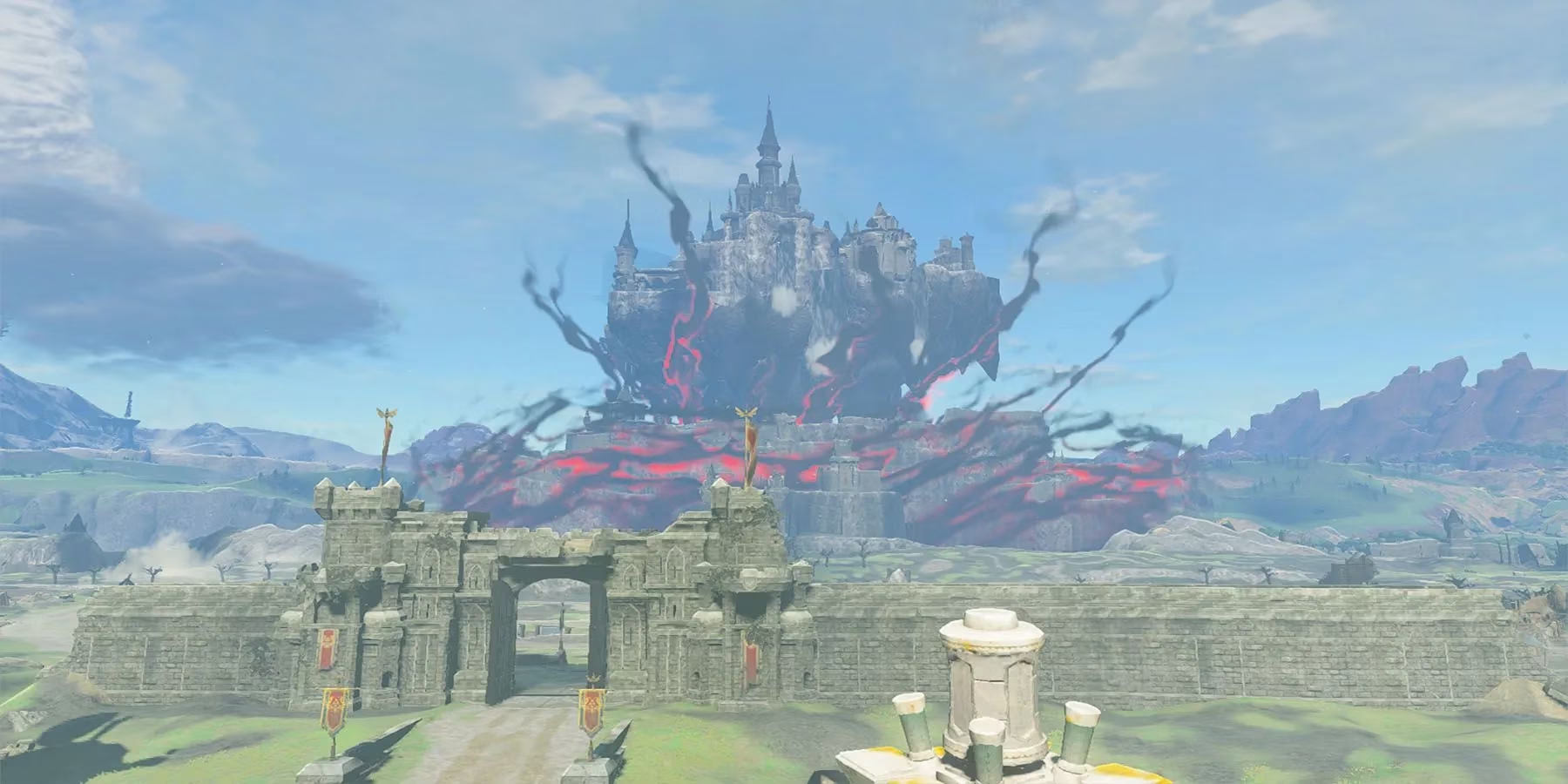
The enormous castle map returns intact from Breath of the Wild, with reduced Malice and Guardian presence opening new routes. The joy of exploring it on one’s own terms is undeniable. Players can spend hours tracking down the Hylian Shield, finding the new Champion’s Tunic, and uncovering the quiet details peppered throughout the halls. That self-directed exploration is exactly what made Breath of the Wild’s Hyrule Castle one of the greatest dungeons in franchise history.
And then the story gets involved. The brief time Hyrule Castle spends as an actual story dungeon is a total letdown. The crown jewel gets reduced to a linear monster gauntlet, the freedom vanishes, and players are funneled through encounters that feel like padding. The promise of a chaotic Phantom Ganon fight at the end is the only thing that makes the journey worth it.
For most players in 2026, Hyrule Castle lives on as a fantastic optional zone to explore at leisure. Its reputation as a dungeon, however, remains heartbreaking. It’s a ghost of what it was, a reminder that even the best designs can be undercut by scripting that wasn’t ready to trust the player. Maybe that’s the strangest irony of Tears of the Kingdom’s dungeon philosophy: when the game fully lets go, it soars. When it tries to tighten the reins, things get wobbly.
For those who are revisiting Tears of the Kingdom or diving into it for the first time, the experience of these dungeons often sparks discussions about value—whether in time spent, challenges encountered, or overall satisfaction. It’s a reminder that gaming isn’t just about the moments we play, but also about the choices we make along the way, both in-game and out.
If you’re considering expanding your gaming library or exploring other titles with similar open-world dynamics, it’s worth checking out where to get the best deals. You can compare prices here and ensure you’re making the most of your gaming budget while diving into new adventures.