Seven years have passed since I first walked the rain-slicked, neon-drenched streets of Night City in Cyberpunk 2077. The city became my home, its skyline a digital tattoo on my consciousness, and the first-person lens through which I saw it became my true eyes. Now, as whispers of the sequel, Project Orion, drift through the net, a profound sense of familiarity and anticipation washes over me. The recent word from the Boston outpost of CD Projekt Red, a call for animators who can craft "immersive first-person experiences," is not just a job listing; it is a promise. A promise that the soul of that original, breathtaking, and deeply personal perspective will live on. I remember the initial wave of doubt back in 2018 when the perspective was revealed. There was a clamor, a question of "Why not third-person?" But I knew, as the studio knew, that to truly be in Night City—to feel the grime, the awe, the sheer oppressive scale of its megastructures, to lock eyes with a Fixer in a moment of tense, unscripted intimacy—you had to see it through V's eyes. That vision was vindicated, not just by critical praise, but by the 30 million souls who have since called Night City home. Project Orion is choosing to build upon that monumental foundation, and my heart soars at the thought.
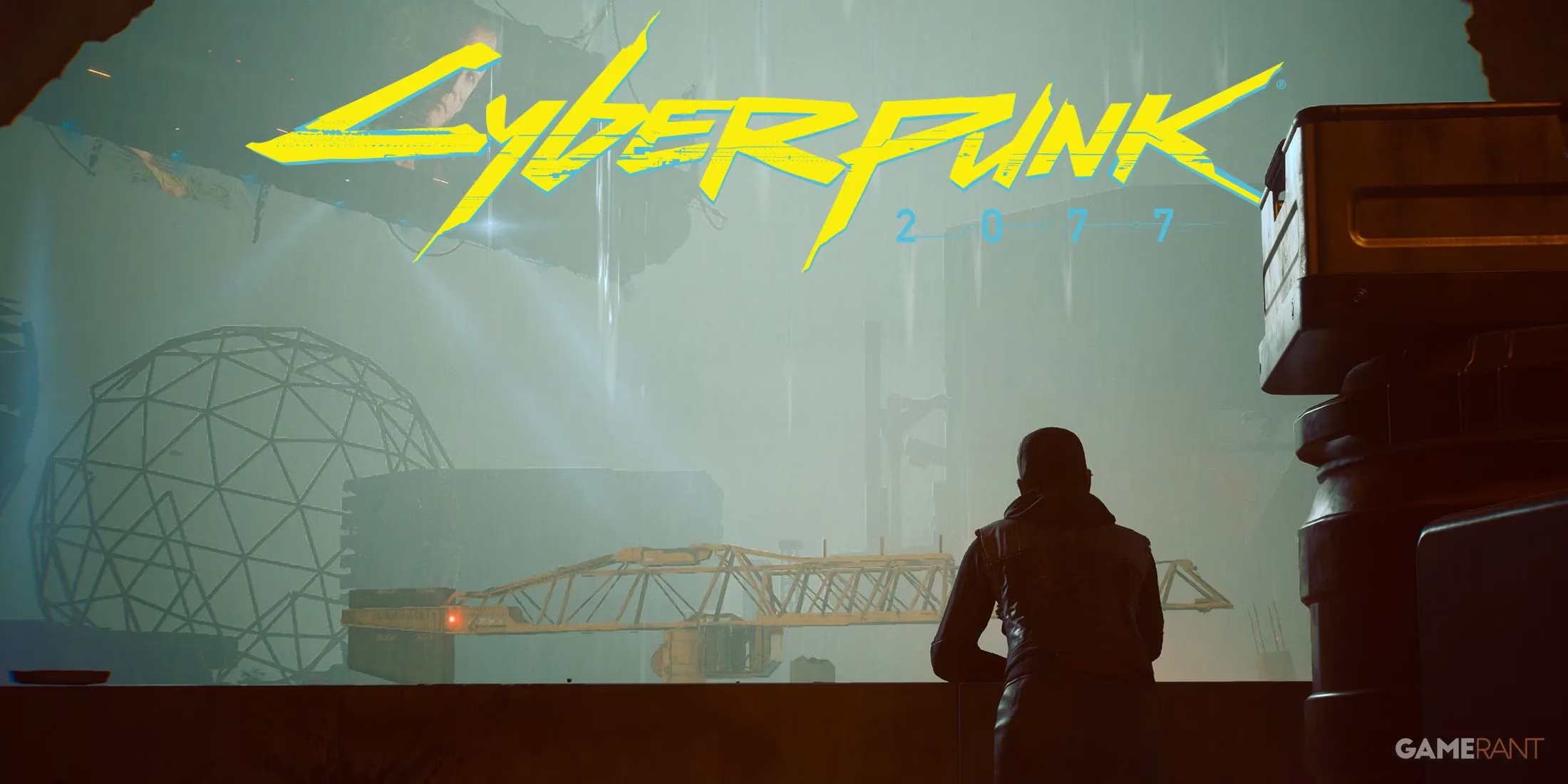
The confirmation is a quiet anchor in the sea of speculation surrounding Orion. Since its announcement in the fading light of 2022, details have been as scarce and precious as a relic from the Time of the Red. We've gleaned hints from the digital breadcrumbs of job postings, each one a fragment of a larger, still-hidden truth. This latest fragment tells us the perspective remains, a core tenet of the experience. It suggests a philosophy of evolution, not revolution. Why alter the very gaze that made the world so tangible, so real? The first-person view was more than a camera angle; it was the conduit for the game's greatest strengths:
-
A Sense of Monumental Scale: Gazing up at the towering Arasaka Tower wasn't just looking at a big building; it was an act of neck-craning awe, a feeling of being an ant in a steel and glass colony.
-
Unmatched Intimacy in Narrative: Conversations weren't watched; they were lived. Every micro-expression on Judy's face, every weary line around Viktor's eyes, was felt, not just observed.
-
Pure, Unfiltered Immersion: From the UI dancing in my retinal display to the way my own hands interacted with the world, the barrier between player and protagonist dissolved.
And let us not forget the graceful compromise of the past—the option to swing the camera out to third-person while careening through the Badlands in a stolen Rayfield. This small liberty acknowledged the joy of seeing your custom-built legend in action, a detail I dearly hope Orion retains and refines. The promise is of a familiar, yet undoubtedly expanded, visual language.
Yet, for all this exciting continuity, the same job listing casts a sobering, almost melancholic shadow. It speaks of a project still in its "pre-production" phase. The words settle like a cold rain. I let my mind drift back to late 2022, when Orion was but a spark of an idea, and I realize that spark is still being carefully nurtured, not yet thrown onto the kindling of full-scale development. The path ahead is long and intertwined with another legend. Project Polaris—The Witcher 4—only began its full production march in late 2024. Its journey to market is unlikely to conclude before the tail end of 2027.
This timeline paints a picture of Orion's future that stretches the horizon nearly to the point of abstraction. A tentative release window in the late 2020s or, more realistically, the early 2030s. Let that sink in. 2030. The implication is staggering: the Night City I may next explore could be one built for hardware that doesn't yet exist in my living room. The current sentinels of gaming, the PS5 and Xbox Series X/S, may be relics by then, left behind in the relentless march of silicon progress. Project Orion might be a native citizen of the next generation, a beacon designed for the uncharted capabilities of consoles forecast for the 2027-2028 frontier. It is a game not just of the future, but for the future.
So here I stand, in 2026, caught between the warm comfort of a confirmed perspective and the vast, cool uncertainty of a distant launch. I am armed with patience, a virtue any Netrunner learns in the slow, careful bypass of a Black ICE. CD Projekt Red is weaving a complex tapestry, with the threads of Polaris and Orion intertwined. They are building not one, but two worlds, and such craftsmanship cannot be rushed. The first-person view is the loom on which they will weave Orion's story. I will wait for it. I will dream of new neon-lit alleys to wander, new fixers to meet eye-to-eye, new heights of megabuildings to gasp at. When Orion finally rises, whether it's at the end of this decade or the dawn of the next, I will be ready to step back into that perspective, to once again feel the digital rain on my face, and lose myself in the beautiful, brutal promise of a new Cyberpunk dawn. The journey continues, and I will see it through my own eyes.