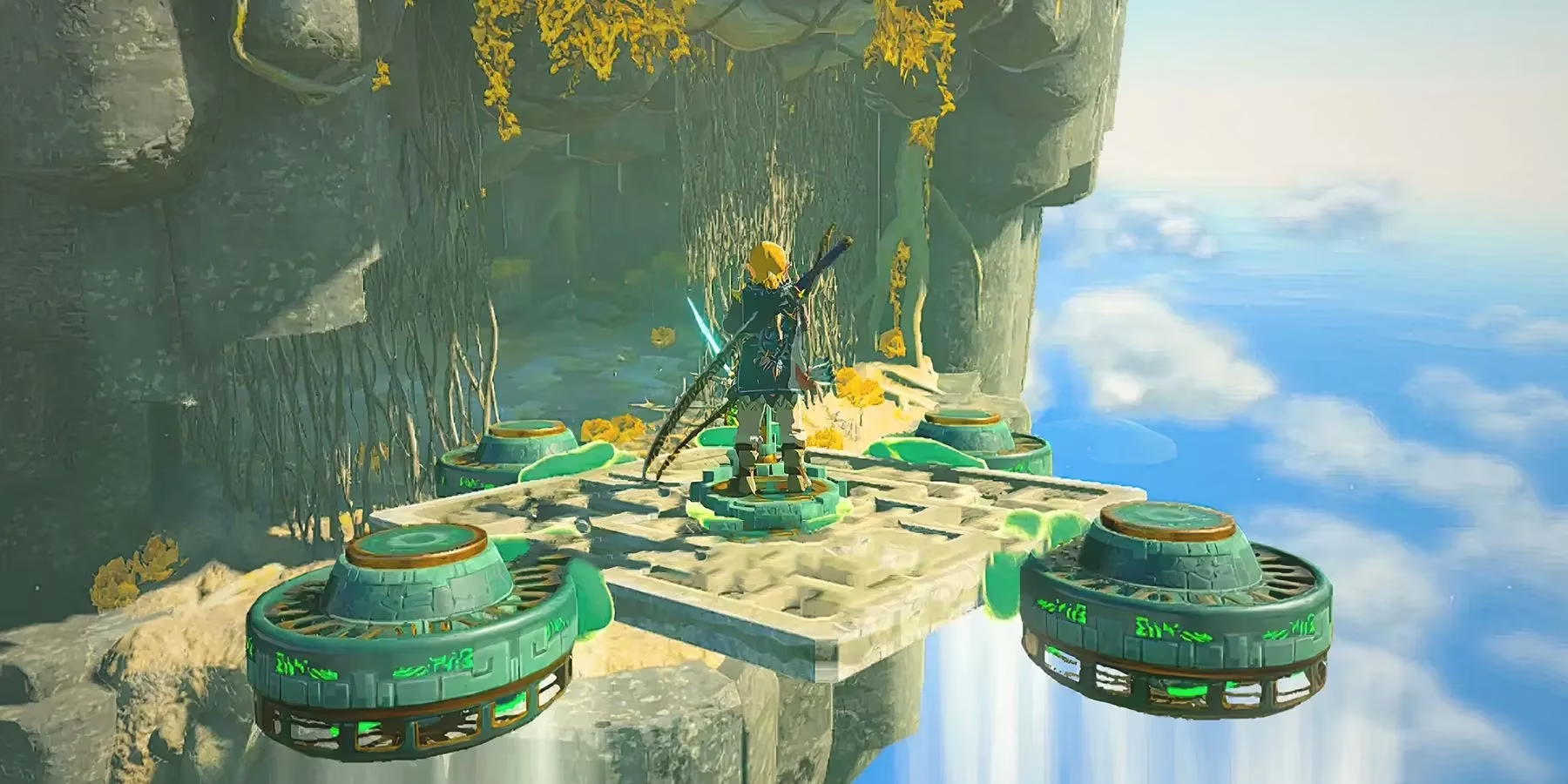
I still remember the first time I soared over Hyrule on a rickety plank powered by two fans. That was back in 2023, when Tears of the Kingdom had just been unleashed and every player was fumbling with Zonai components. Fast forward to 2026, and the engineering feats in this game have evolved into something truly breathtaking. After countless hours in the Depths and dozens of failed prototypes, I finally assembled my own version of the legendary combat gunship that has been tearing through monster camps with ruthless efficiency.
My journey began when I stumbled upon the work of a player known as Ultrababouin. This dedicated engineer has been a trailblazer since the early days of the game, sharing a series of ever more deadly combat drones and aircraft that pushed the limits of Ultrahand. Their latest design—nicknamed “the best gunship yet”—became my obsession. I studied every screenshot and breakdown they posted, determined to not only replicate it but truly understand the subtle interactions that made it so ferocious.
The core of the build revolves around making the most of the game’s 21-component limit. At first glance, the gunship looks like chaos welded onto a cockpit, but every piece has a purpose.
The Secret of the Cockpit
Instead of using standard wooden planks or metal plates, I sourced a guard rail from the Construct Factory deep in the Depths. This component is currently one of the lightest known objects in Hyrule and possesses extraordinarily floaty physics. When attached correctly, it keeps the entire machine buoyant without draining battery life too quickly. I remember the first time I pried it loose with a stabilizer-assisted launch—it felt like stealing fire from the gods.
Propulsion That Defies Gravity
The true heartbeat of the gunship comes from twin propellers stolen from the Gemimik Shrine in eastern Hyrule. These aren’t just slapped on; I connected them using a Zonai Big Wheel that forces them to spin at an accelerated rate. The result is a propulsion system that generates lift far beyond any fan or rocket. To integrate this seamlessly with the cockpit, I employed a technique called stake nudging. By anchoring components temporarily with stakes and nudging them into precise positions, invisible connections can be formed between objects. This was a game‑changer technique discovered by the community around 2024 and has since become standard practice for compact, stable builds. The propulsion unit being nudged onto the guard rail chassis meant my gunship stayed rock‑solid even during sharp turns.
Weaponry Designed for Obliteration
Beneath the floating fortress, an array of Zonai Beam Emitters is mounted on a Construct Head. Anyone who has experimented with automated combat knows that the Construct Head is one of only two components in the entire game capable of automatically aiming at enemies. It locks onto Bokoblins, Lizalfos, and even constructs the moment they enter range. I supplemented the emitters with two Zonai Stabilizers to counteract the recoil and keep the nose always pointing at the target. The first test flight over the Gerudo Highlands was unforgettable—a Silver Lynel that usually terrifies me was reduced to a puddle of smoke in seconds, never even landing a hit.
Fine‑Tuning and Community Evolution
What makes this gunship particularly special is how it encapsulates three years of collective learning. When I first tried building combat aircraft in 2023, I would lose pieces to slight bumps or run out of energy in midair. Now, thanks to shared knowledge, I know to balance weight distribution using glue‑loop techniques and to position the stabilizers exactly 45 degrees off the center axis for the best maneuverability. The 21‑component ceiling used to feel restrictive; today it’s a puzzle that forces creativity. Every lash, every fused segment is a deliberate choice.
In late 2025, a detailed tutorial for this exact design was finally shared by Ultrababouin, which let me add my own flair—like swapping the beam emitters for frost cannons during hot summer skirmishes in Eldin. The modular nature of the construction means I can reconfigure it quickly for different biomes.
The Joy of Endless Experimentation
Walking up to my hangar in Tarrey Town, looking at the dozens of gunship iterations I’ve built, I realize that Tears of the Kingdom has become more than a game for me. It’s a workshop where physics, imagination, and a bit of Hyrulean magic intersect. The combat drone I cobbled together back in June 2023 feels prehistoric compared to the sleek death machine I pilot now. I urge any player, whether they are just starting or have been tinkering for years, to push beyond what seems possible. The next revolutionary building technique is probably already hiding in a shrine puzzle or a scrap yard in the Depths.
My gunship now sits proudly on the loading screen, a symbol of how far the creative spirit can soar. And tomorrow? I’ll probably strip it apart and try to build a dragon‑sized version that lands itself automatically. In Hyrule, challenges never end, and neither does the relentless march of innovation.