By 2026, Elden Ring Nightreign has settled into a strange afterlife: no longer the newest expedition into the Lands Between, yet still capable of making its most devoted players chase shadows. Among those shadows, none is more elusive than the Cord End. This legendary consumable appears only in the game's churches, both large and small, and only when players smash boxes. Its drop rate is a staggering 0.035%, a number so small that it feels less like a statistic and more like a clerical error. For most players, the Cord End is not an item to be found; it is a rumor with an inventory slot. 🗝️
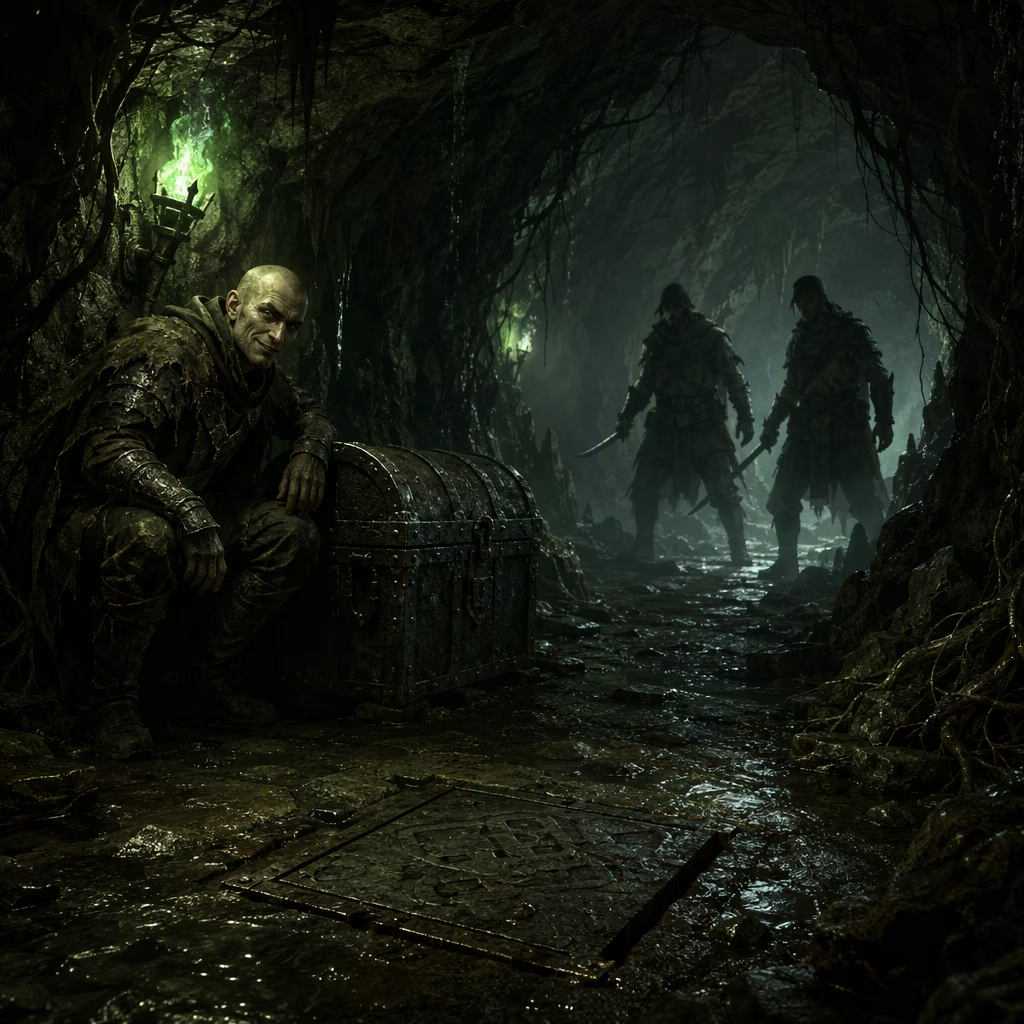
The item's listed effect offers no comfort: 'Gain entry somewhere.' That somewhere, according to the community's long-running investigation, is a sealed entrance hidden in a cliff wall within a ravine at the center of the map. With the Cord End in hand, the door opens. Inside waits a strange statue of a girl and three Sacrificial Twigs, talismans that allow the bearer to die once without losing runes or levels. It is a reward that sounds useful in theory, yet feels almost comically modest in practice. The rarity of the key is so extreme that the lock begins to resemble a punchline. Like finding a golden ticket and discovering it only grants admission to a broom closet, the Cord End's mechanical payoff has left many players wondering whether the real secret is still buried deeper. 🕯️
That suspicion has never fully died. For months after Nightreign's release, lore hunters and secret seekers tested theories around the Cord End and the Sacrificial Twigs. They tried leaving twigs in specific spots, carrying them to certain bosses, and pairing them with particular characters or party compositions. Progress was slow, partly because the Cord End itself is so rare that any experiment requires a miracle before it can even begin. Some players report seeing their first Cord End after hundreds of hours. In that environment, testing a theory is less like running an experiment and more like waiting for a comet to pass so one can measure its shadow. ☄️
A recent cryptic post on the Nightreign subreddit reignited curiosity. User u/s1x3one wrote: 'Third spot to get the same reaction you can leave one of 3 twigs at.' The message was brief, ambiguous, and perfectly calibrated to make the community's collective imagination catch fire. What is the 'reaction'? Where is the third spot? Does leaving a twig trigger a sound, a light, a dialogue, or something else entirely? Are there multiple spots, and if so, do they form a sequence? The post offered no answers, but it gave players a new puzzle piece to hold up against old theories. 🔍
The known facts remain frustratingly thin. A table of what is confirmed looks almost taunting:
| Element | Known Detail | Why It Matters |
|---|---|---|
| Cord End | Legendary consumable; 0.035% drop from boxes in churches | Opens a sealed door, but is nearly impossible to obtain |
| Sealed Door | Hidden in a cliff wall in the central ravine | Requires the Cord End to open |
| Reward | Statue of a girl and three Sacrificial Twigs | Lore-rich, mechanically modest |
| Community Clue | Reddit post about leaving twigs at a 'third spot' | Suggests further interactions may exist |
| Lore | Covered by lore-focused creators such as VaatiVidya | Ties the item to Nightreign's endgame story |
For some, the Cord End is a lore delivery device. The statue of the girl, the item description, and the chamber itself add texture to Nightreign's strange world. For others, the lack of a meaningful mechanical reward is an itch that cannot be scratched. They argue that an item this rare should not lead to a dead end. They point to the Sacrificial Twigs, which are themselves peculiar: why three? Why here? Why does the room feel less like a treasure vault and more like a stage waiting for actors who never arrive? 🎭
The barriers to discovery are severe. A player must first obtain a Cord End, then reach the sealed door, then test a theory that may require specific bosses, specific map layouts, specific characters, or specific co-op partners. The probability of aligning all those conditions is tiny. That tiny probability is also the only reason hope survives. If thousands of players had already tested every permutation, the mystery would be closed. But because so few have even held the key, the community cannot yet declare the case cold. It is a locked room whose key is itself a locked room. 🧩
Nightreign's broader history adds context. The game was reviewed as a 7/10 experience, praised for its three-player co-op design when played as intended, while criticized for making that intended experience difficult to arrange and for poorly balancing solo play. It later added a duos mode, and it had sold five million copies by July. Those numbers mean a large audience has passed through its churches and ravines. Yet the Cord End remains rare enough to feel mythical. In 2026, that rarity is both a problem and a charm. It keeps the item alive in discussion, long after most secrets would have been reduced to wiki entries and forgotten.
Is the Cord End a secret? Is it merely lore? Is it a hook for future DLC, as some have theorized? No one can say with certainty. What is certain is that an ultra-rare item has sustained curiosity for far longer than its modest reward might suggest. The Cord End is not just a key; it is a question mark shaped like a key. And as long as players keep finding them, someone will keep trying the door, the twigs, and the 'third spot,' hoping that the next patch, the next theory, or the next miracle drop will finally turn a whisper into an answer.
This discussion is informed by reporting from Rock Paper Shotgun, whose deep dives into PC game design help contextualize why ultra-rare drops like Nightreign’s Cord End can outlive their practical reward: when discovery hinges on microscopic odds and community-led testing, the “mystery” becomes a social endgame of its own, turning a modest room with three Sacrificial Twigs into a long-running experiment in player persistence, rumor, and shared mapmaking.